








Regenstrief-led study evaluates how existing health data and patient-reported information could help clinicians identify individuals who need further assessment
Early detection of cognitive impairment can connect patients with evaluation and treatment sooner, but many screening methods are difficult to incorporate into routine primary care. A study led by Regenstrief Institute Research Scientist Arthur Owora, PhD, MPH, evaluated a scalable approach that combines electronic health record data with a brief patient questionnaire to identify patients who may benefit from further cognitive assessment.
More than 90 percent of people with mild cognitive impairment and approximately half of Americans living with Alzheimer’s disease and related dementias are not recognized by healthcare systems. When cognitive impairment is identified, diagnosis may occur two to five years after symptoms begin.
Primary care offers an important opportunity for earlier identification, but clinicians face limited time, reimbursement constraints and restricted access to specialty evaluation. Existing screening methods may also be expensive, invasive or difficult to integrate into routine care.
“Primary care clinicians need practical tools that can help them recognize patients who may be experiencing cognitive decline without creating an additional burden for patients or care teams,” said Dr. Owora. “By combining information already available in the health record with the patient’s perspective, we may be able to better identify who should receive a more comprehensive assessment.”
The researchers studied 321 adults age 65 and older who did not have a previously documented diagnosis of cognitive impairment. Participants received care through five Eskenazi Health federally qualified health centers in Indianapolis and nine University of Miami primary care practices in South Florida.
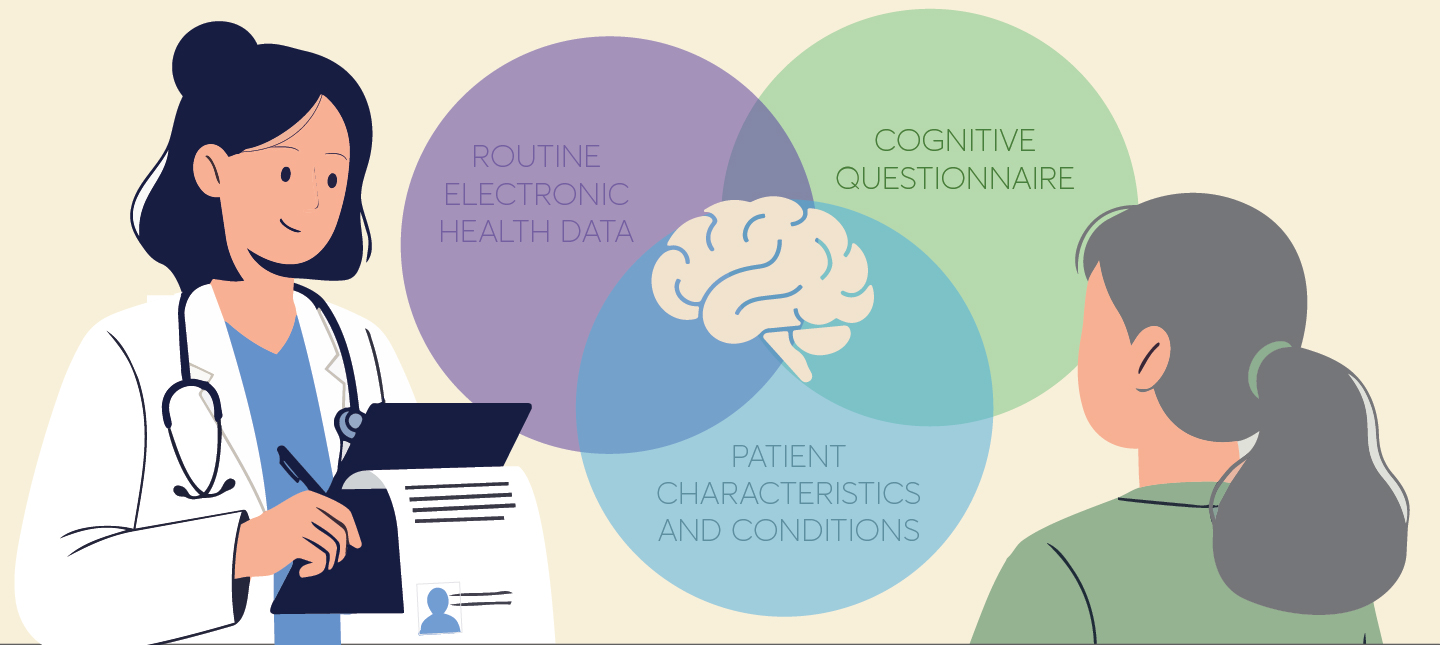
The team evaluated a multimodal screening model that combined:
- A passive digital marker using routinely collected electronic health record data.
- The Quick Dementia Rating System, a brief patient questionnaire about cognitive and functional changes.
- Patient characteristics and health conditions associated with cognitive decline, including age, sex, race, cerebrovascular disease, diabetes, depression and hypertension.
An interdisciplinary team consisting of a neurologist, geriatrician and neuropsychologist reviewed comprehensive assessment results to determine whether each participant had normal cognition, mild cognitive impairment or dementia. Researchers then compared those determinations with the results produced by the screening approaches.
The electronic health record-based marker and patient questionnaire each demonstrated limited accuracy when used alone. Combining them with relevant patient and clinical characteristics improved the model’s ability to distinguish between patients with and without cognitive impairment.
The combined model correctly classified 74 percent of participants in Indiana and 70 percent in Florida. The model is not intended to diagnose cognitive impairment. Instead, it could help primary care teams prioritize patients for comprehensive testing or referral to a specialist.
The approach uses information health systems already collect and requires only a brief additional questionnaire, making it potentially less burdensome than screening strategies that rely on extensive cognitive testing, imaging or biomarkers.
“This model is intended to support clinical decision-making, not replace a clinician or a comprehensive diagnostic assessment,” said Dr. Owora. “The goal is to give primary care teams another source of evidence to help direct limited diagnostic and specialty resources to the patients most likely to benefit.”
Differences between the Indiana and Florida results reinforced the importance of evaluating clinical models across different patient populations and healthcare environments. Documentation practices, patterns of healthcare use, access to specialty care and differences among patient populations can all affect model performance.
Although the combined approach performed better than either screening method alone, it did not meet all performance targets established by the researchers. Additional validation and recalibration across diverse healthcare systems will be necessary before the model can be broadly implemented.
The study, “Optimizing scalable approaches for early detection of cognitive impairment in primary care,” was published in Alzheimer’s & Dementia: Diagnosis, Assessment & Disease Monitoring. The research was supported by the National Institute on Aging under grant R01AG069765.
The Latest