





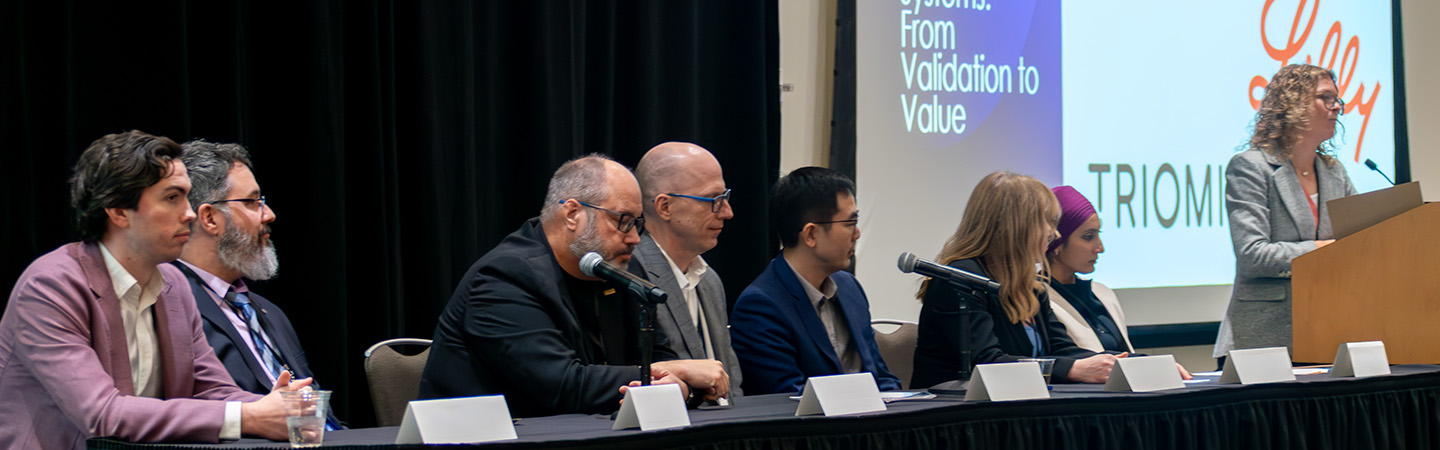

Representatives from reference labs, healthcare providers, government agencies, insurance companies, software and device manufacturers and researchers from 14 countries mapped test codes, explored innovation through artificial intelligence and discussed digital health and interoperability during the LOINC® conference, October 7-10 in Montréal, Canada.
Keynote presenters were:
- Abhi Kalra, EVP, Canada Health Infoway
- Rishi Manchanda, HealthBegins
LOINC Award for Distinguished Contributions
This award honors an individual who has made sustained and enduring contributions that advance health data interoperability with LOINC. The 2025 awardee was Anil Patel with Canada Health Infoway.
Stan Huff Education Award
This is awarded to a student(s) studying health informatics or a related field. The 2025 Stan Huff Education awardees were:
- Grazia Serratore, PhD program, student in Technology Applied to Cultural Heritage program at the University of Calabria, Italy.
- Kristi Pennypacker, master’s program, student in healthcare administration at Capella University.
- Audra Stepanauskaitė, bioinformatics student at Vilnius University in Lithuania, and employee at Lithuanian Medical Library’s E-Health Center.
- Albert Kušlevič, student at Vilnius University in Lithuania, and team member at the Lithuanian Medical Library’s E-Health Center.
Additional presentations and presenters were:
- Computational LOINC to Support Healthcare and Biomedical Research, Shahim Essaid, M.D., University of North Carolina.
- OHDSI in Action: A Global Collaboration to Develop Sustainable Solutions for Representing Race and Ethnicity, Melanie Philofsky, M.S., EPAM Systems.
- Mapping of LOINC and Japan’s JLAC standard applying Generative AI for international collaborative research, Mihoko Okada, PhD, Institute of Health Data Infrastructure for All, Shinya Yamamoto, PhD, Tohoku University.
- Standardizing Healthcare Data for Enhanced Epidemiological Surveillance: A Belgian Project, Ann Verdonck, UZLeuven Laboratory Medicine.
- Coding guidance for lab observations in German EHRs, Jeremy Lieth and Christine Haas, Federal Institute for Drugs and Medical Devices.
- Use of LOINC Groups in Clinical Document Integrity Processes, Pamela Banning, MLS(ASCP)cm, PMP, Solventum Health Information Systems, Inc.
- Standardizing Information in Laboratory Diagnostics in Poland: Integrating LOINC into the national health system, Ewa Balcerczak, Rafał Świechowski, PhD, and Adam Kozierkiewicz, M.D., PhD, Medical University of Lodz.
- Document Ontology and pCLOCD, Anil Patel, Canada Health Infoway.
- Next-Generation Terminology Mapping for the Post-RELMA Era: OCL Mapper, Jonathan Payne, M.S., Open Concept Lab, Michaël Bontyes, Madiro/Doctors Without Borders, and Joe Amlung, Regenstrief Institute.
Partners

The Latest