








With the support of a new $3 million, five-year National Institute on Aging grant, researchers from the Regenstrief Institute and Indiana University Center for Aging Research are conducting the first evaluation of the benefits and harms of Alzheimer’s disease screening for family members of older adults.
A majority of individuals with Alzheimer’s receive care from family members — most commonly spouses or adult children or siblings — but the effect of early identification of Alzheimer’s by screening on these caregivers has never been determined.
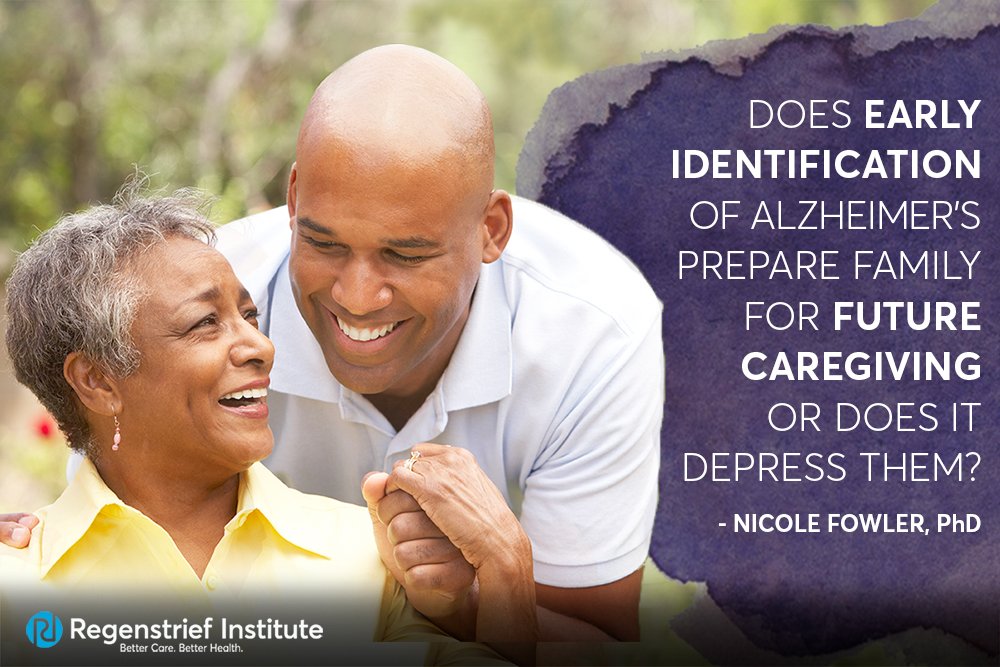
“Does early identification of Alzheimer’s by screening prepare family members for a future caregiving role or does it depress them?,” queries Regenstrief Institute and IU Center for Aging Research investigator Nicole Fowler, Ph.D., the principal investigator of the new study. “We know that a delayed dementia diagnosis may perpetuate family beliefs that changes in cognition are part of ‘normal aging’. These are beliefs that have been shown to aggravate caregivers’ stress, burden and sense of isolation.
“But what we don’t yet know is — if by identifying possible Alzheimer’s early — if we can better prepare family members for a caregiving role and reduce their burden.”
The new study is enrolling 1800 adults age 65 and older who have not been diagnosed with Alzheimer’s or other dementias or serious mental illness. Additionally, the family member who each older adult indicates would be most likely to be a caregiver if needed (a total of 1800 potential caregivers) will be enrolled in the study, which is known as COADS, short for Caregiver Outcomes of Alzheimer’s Disease Screening.
Each pair of older adult and family member participants will be randomized into one of three groups and tracked for 24 months.
The older adults in Group I will not receive Alzheimer’s screening. The family members will not be given any information about their older adults’ cognition.
The older adults and family members in Group II will be randomized to Alzheimer’s screening and will be told about the older adults’ Alzheimer’s screening results. For example, they may be advised that based on screening test performance it appears that the older adult may have memory issues and that they should follow up with their doctor. The older adult’s physician will be made aware of the screening results.
The older adults and family members in Group III will be randomized to Alzheimer’s screening and will be told about the older adults’ Alzheimer’s screening results. If the older adult has screened positive for cognitive impairment, a referral will be given to the evidence-based Aging Brain Care (ABC) Program at Eskenazi Health for diagnostic evaluation and will be offered dementia collaborative care management if Alzheimer’s is diagnosed.
“You wouldn’t screen for any other condition and do nothing with a positive result,” said Dr. Fowler, who, in addition to the Regenstrief Institute is on the faculty of IU Center for Health Innovation and Implementation Science and IU School of Medicine. “Best practice is if you are going to screen, you also need to provide state-of-the-science diagnostic care and care management. That’s what we will offer the older adults and family caregivers in Group III to see if it makes a difference for caregivers.
“We can’t stop the train from leaving the station, but we can help the journey for both the older adults and their families. This study will answer the question of how screening for Alzheimer’s affects that crucial individual — the family caregiver.”