









In one of the first investigations of the effectiveness of a second mRNA booster against COVID-19 Omicron variants, a study from the U.S. Centers for Disease Control and Prevention (CDC) has found that a second booster shot significantly improved effectiveness against widespread variants Omicron BA.1 and BA.2/BA.2.12.1.
With the first booster, vaccine effectiveness against these variants was only 68 percent (lower than against previous variants) and declined to 52 percent effectiveness after six months. With the second vaccine, effectiveness against these variants climbed to 80 percent within the first six months. Data is not yet available for effectiveness after six months.
The study looked at effectiveness of the second booster in reducing COVID Omicron BA.1 and BA.2/BA.2.12.1 related hospitalizations and emergency department (ED) visits and found the shot protected against both hospitalizations and ED visits.
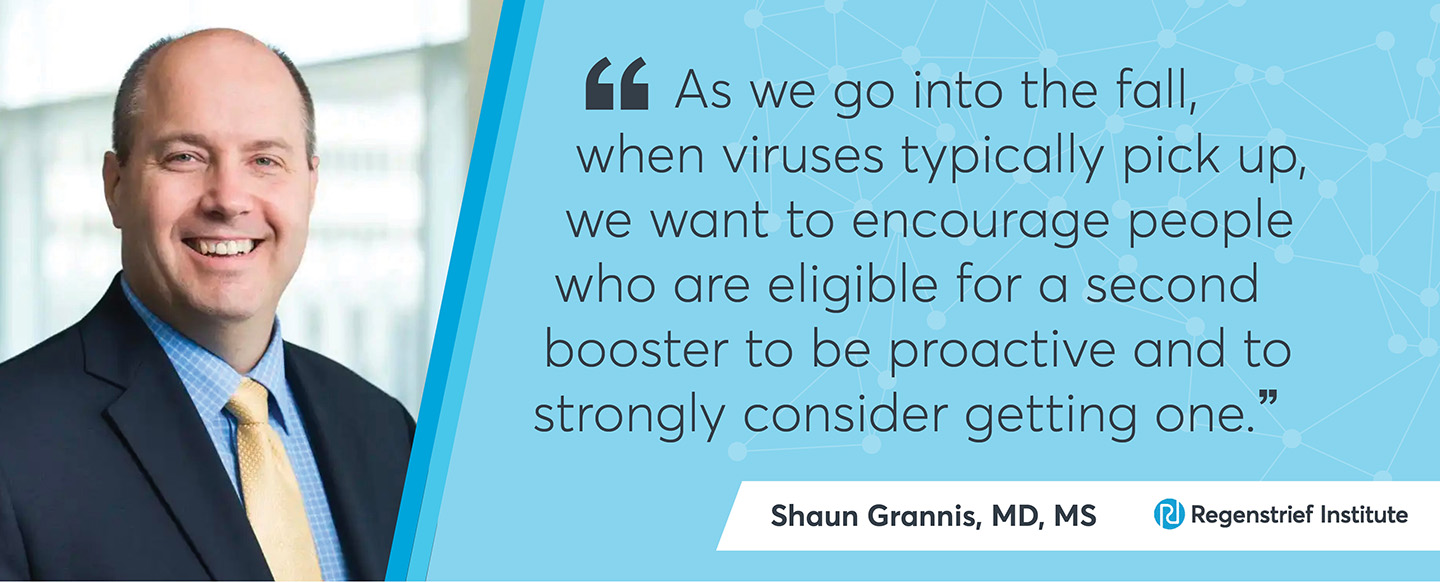
“The findings of this study are important because they provide an answer to a question that many people are asking: Should I get the second booster shot? The data clearly show that a second booster significantly increases vaccine effectiveness against these variants — which while no longer dominant in many areas, are still present,” said study co-author Shaun Grannis, M.D., M.S., vice president for data and analytics at Regenstrief Institute and professor of family medicine at Indiana University School of Medicine. “As we go into the fall, when viruses typically pick up, we want to encourage people who are eligible for a second booster to be proactive and to strongly consider getting one because it will provide greater protection. It will reduce the need for COVID-19-related emergency department visits and hospitalizations.
“From a population health perspective, the protection supplied by the second booster helps ensure that healthcare resources are capable of responding to the full spectrum of medical needs, reducing the chance of overwhelming health systems with COVID-19-related disease.”
Current CDC recommendations for a second booster (fourth shot of the vaccine) are for people 50 and older as well as for moderately or severely immunocompromised individuals who are 12 and older.
“Effectiveness of 2, 3, and 4 COVID-19 mRNA vaccine doses among immunocompetent adults during SARS-CoV-2 Omicron BA.1 and BA.2/BA.2.12.1 sublineage periods – VISION Network, 10 states, December 2021–June 2022” is published in the CDC’s Morbidity and Mortality Weekly Report.
The U.S. Centers for Disease Control and Prevention (CDC) collaborated with seven U.S. healthcare systems plus the Regenstrief Institute, to create the VISION network to assess COVID-19 vaccine effectiveness. In addition to Regenstrief Institute, other members are Columbia University Irving Medical Center, HealthPartners, Intermountain Healthcare, Kaiser Permanente Northern California, Kaiser Permanente Northwest, University of Colorado and Paso Del Norte Health Information Exchange (PHIX). Regenstrief contributes data and expertise to the VISION Network.
Authors of this VISION Network study are from 10 states and 19 institutions, including the public sector, research, clinical and academia. Regenstrief Institute authors, in addition to Dr. Grannis, are Brian E. Dixon, PhD, MPA, Regenstrief Institute and IU Richard M. Fairbanks School of Public Health; William F. Fadel, PhD, and Nimish Ramesh Valvi, DrPH, MBBS, both Regenstrief fellows.
About Shaun Grannis, M.D., M.S.
In addition to his role as the vice president for data and analytics at Regenstrief Institute, Shaun Grannis, M.D., M.S., holds the Regenstrief Chair in Medical Informatics and is a professor of family medicine at Indiana University School of Medicine.
About Regenstrief Institute
Founded in 1969 in Indianapolis, the Regenstrief Institute is a local, national and global leader dedicated to a world where better information empowers people to end disease and realize true health. A key research partner to Indiana University, Regenstrief and its research scientists are responsible for a growing number of major healthcare innovations and studies. Examples range from the development of global health information technology standards that enable the use and interoperability of electronic health records to improving patient-physician communications, to creating models of care that inform practice and improve the lives of patients around the globe.
Sam Regenstrief, a nationally successful entrepreneur from Connersville, Indiana, founded the institute with the goal of making healthcare more efficient and accessible for everyone. His vision continues to guide the institute’s research mission.
About IU School of Medicine
IU School of Medicine is the largest medical school in the U.S. and is annually ranked among the top medical schools in the nation by U.S. News & World Report. The school offers high-quality medical education, access to leading medical research and rich campus life in nine Indiana cities, including rural and urban locations consistently recognized for livability.
The Latest