












Linking Maternal and Child Health Data to Enhance Public Health Surveillance and Implement Sustainable Interventions
IOS Press
Publication: Digital Health and Informatics Innovations for Sustainable Health Care Systems
Maternal-child health is an important area of research in Indiana, and Regenstrief has a wealth of data available for study. Similar to other clinical domains, Regenstrief receives data from multiple sources, including health systems contributing INPC data as well as the Indiana Department of Health. Ongoing work at Regenstrief also links mother and child data through a maternal-child algorithm, allowing study for the mother-baby dyad. Regenstrief Investigators have also been working to develop a pregnancy phenotype that would indicate an ongoing pregnancy for relevant patients. In a recent year, there were 72,960 pregnant women with information within INPC. Nearly all of those deliveries contain demographic information (date of birth, age, address, race, language) and about two-thirds of them (51,512) had information related to the delivery encounter, including admission and discharge dates, length of stay, and disposition of the newborn.
While valuable progress has been made with maternal-child record linkage, implemented linkage algorithms (i.e., to connect health records between mother and baby) are conservative to avoid linking unrelated patients. As a result, there are some unlinked patients in the data. For more information related to the linkage algorithm(s), please see the INPC video link below from Dr. Shaun Grannis.
It is important to note that available maternity-natality data are based on hospital and state records, so births that happen at home or non-hospital centers are largely absent from these data. These births likely account for 3-5% of births in Indiana. Additionally, the birth data within INPC refer to live births, meaning that stillbirth data and information related to infant mortality may not be available. Multiple gestation births are included in the data, but there is imperfect linkage of these births to the mother, as noted above. As a result, there are 76,503 babies for a recent year, nearly 4,000 more than the mothers in the data. However, there are few documented sets of twins, and no documented sets of triplets. Data are continuously undergoing review and quality improvements, so this issue may be addressed in the future.
Another important note is that INPC generally does not receive a lot of procedure data. As a result, information regarding cesarean sections is limited. Similarly, events or diagnoses that are related to procedures such as a cesarean section (vaginal birth after cesarean, or VBAC) are likely to be unavailable or unreliable. Maternal morbidity events related to the delivery are less likely to be available and reliable if they are related to procedures (for example, there are not data available for hysterectomies or temporary tracheostomies, but there are data for non-procedural events such as amniotic embolism, renal failure and pulmonary edema). Some events that clinicians may not think of as classically procedural (i.e., blood transfusions) are treated as procedural in the INPC data. Thus, while there are about 1,500 cases of postpartum hemorrhage for a recent year, there are no blood transfusions recorded, which is unlikely to be accurate. In some cases, it may be possible to obtain this information through manual chart review or unstructured clinical documentation. Finally, some birth-related procedures (e.g., forceps delivery or vacuum delivery) have discrepancies between the number documented in the newborns’ charts and the mothers’ charts (263 vacuum deliveries documented in the newborn charts vs. fewer than 10 documented in the mothers’ charts). Some of this information may be recoverable through chart linkage, but requesting only maternal data for these procedures is likely to misrepresent frequency.
Many obstetric variables, including parity, gravidity, and flags for specific pregnancy-related conditions such as pre-eclampsia are typically based on information embedded within clinical notes rather than recorded as separate discrete variables. This means that manual chart review will likely be required for research studies. However, some of these obstetric variables are available as part of the Indiana University and Eskenazi Health enterprise data warehouses as structured variables and may be of interest to researchers wanting to analyze health records of a diverse cohort that skews urban. Gestational age is also unavailable as a structured variable through INPC. There are very few APGAR scores available as structured variables (1,030 in a recent year with more than 76,000 births). Thus, research using this information would likely require manual review of clinical documentation. This may be possible only for a subset of the total births.
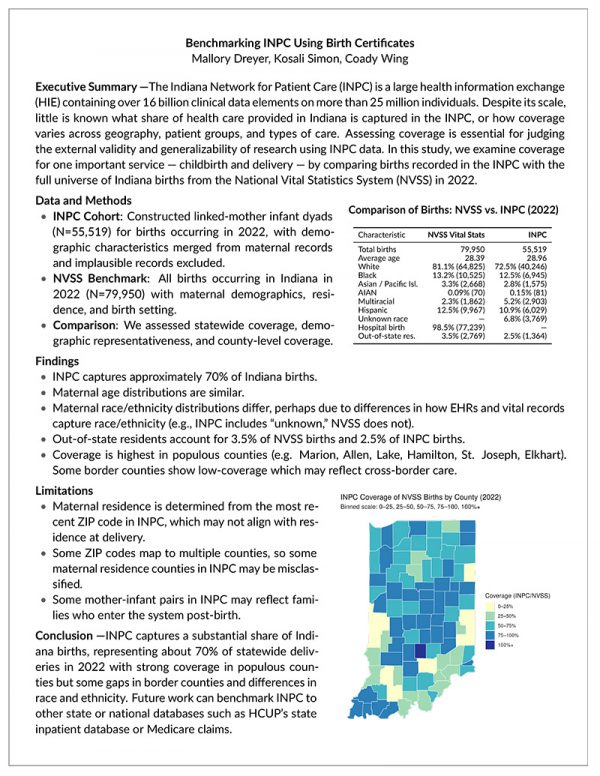
Drs. Coady Wing and Kosali Simon have compared the birth data available through INPC to the full population of Indiana births available through the National Vital Statistics System (NVSS) in 2022. Overall, INPC captures about two-thirds of Indiana births, and representativeness is quite good. The best coverage occurs in the most populous counties. Note that there are occasional inconsistencies between INPC data and those available through NVSS.
Brian Dixon, PhD, MPA
Shaun Grannis, MD, MS
Jill Inderstrodt, PhD, MPH
Kosali Simon, PhD, MA
Coady Wing, PhD, MA
IOS Press
Publication: Digital Health and Informatics Innovations for Sustainable Health Care Systems

Publication: International Journal of Population Data Science
Publication: Journal of the American Medical Informatics Association
Before beginning a research project in this area, you may wish to review the Regenstrief Data Guide
which describes available data in more detail. You can also join the INPC Users Group here
by checking ‘Regenstrief Data Services’. Alternatively, you can email askRDS@regenstrief.org.

RDS would like to hear about it, promote your work, and help make collaborative connections. Please share your scholarly products or findings by emailing askRDS@regenstrief.org.