








A project from Regenstrief Institute and the IU Richard M. Fairbanks School of Public Health at IUPUI (FSPH) took home the top prize in the inaugural Indiana Inject Tech Challenge from BioCrossroads.
The team won for a platform designed to effectively access data on patients’ social factors and leverage that information, enabling health care organizations to provide more holistic care. Addressing these social determinants of health has the potential to save a health system $1.4-2.4 million each year in avoided hospitalization costs.
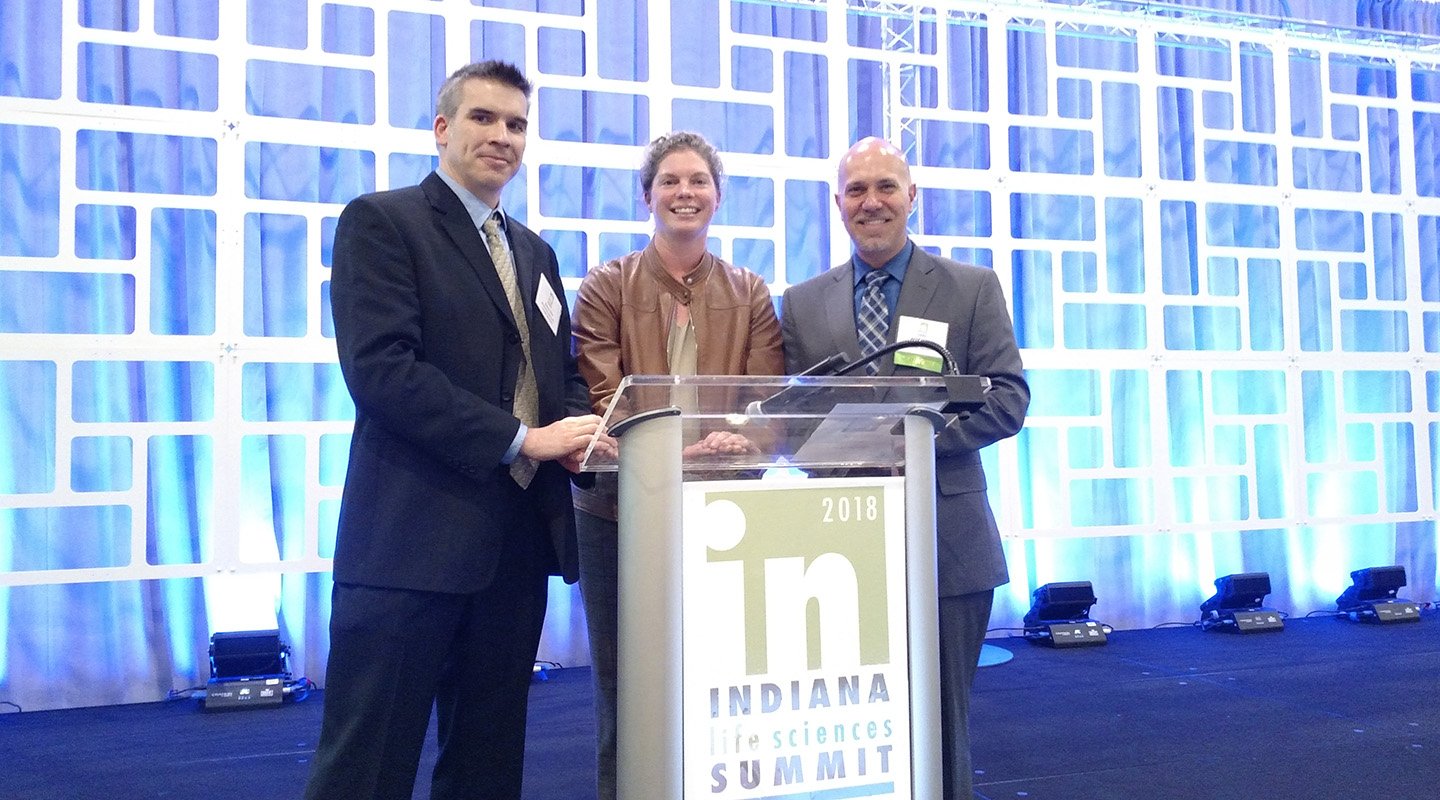
The Regenstrief/IU FSPH team was led by Josh Vest, PhD, and included Shaun Grannis, MD, Suranga Kasthurirathne, PhD, Nir Menachemi, PhD, and Paul Halverson, DrPH.
The two other finalists were Indianapolis-based DigiBiomarker, an innovative platform capable of capturing digital information directly from patients through their smartphones or via a web application; and Indianapolis-based Ecogenesis11, developing an artificial intelligence-based clinical trial platform to recruit and retain patients.
The Inject Tech Challenge is a digital health competition seeking to catalyze the creation of new solutions designed to improve patient outcomes. The winner was announced at the Indiana Life Sciences summit.
The competition accepted entries that addressing one of four challenge statements:
- Digital health and mobile medical solutions for measuring/monitoring/treating disease progression in chronic pain conditions, prediabetes/diabetes, and/or diabetic complications through novel endpoints.
- Identify a portable and fungible (across electronic health record data systems) solution to engage healthcare providers, enabling and incentivizing referrals (using workflow management and compensation features) into clinical research.
- Innovative, total support system/model to enable clinical trial participation of diverse populations.
- A solution to transform and merge “omics” data and clinical data through advanced analytics and machine-learning to enable a new level of data interoperability, accessibility, and security.
The Latest